Routage d’emails entrants

Routage d'emails entrants

Automatisez, analysez et acheminez facilement vos emails entrants

Mettez en place des communications bidirectionnelles par email directement dans vos applications
Inbound Email Catchall

Créez des conversations avec vos utilisateurs

Permettez à vos utilisateurs de vous répondre ou simplement d’envoyer des emails à votre app via JSON.

Utilisez n’importe quelle adresse, notre Catchall s’occupera du reste
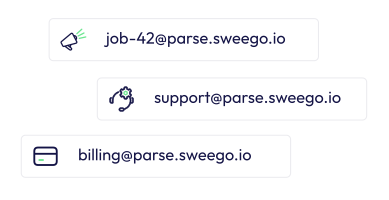
Inbound email CatchAll
Email to JSON

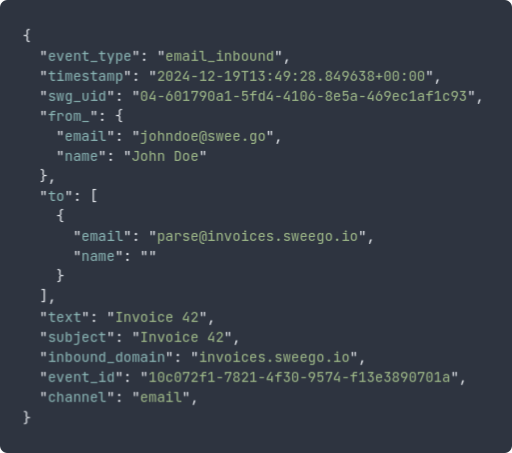
Vos emails en JSON

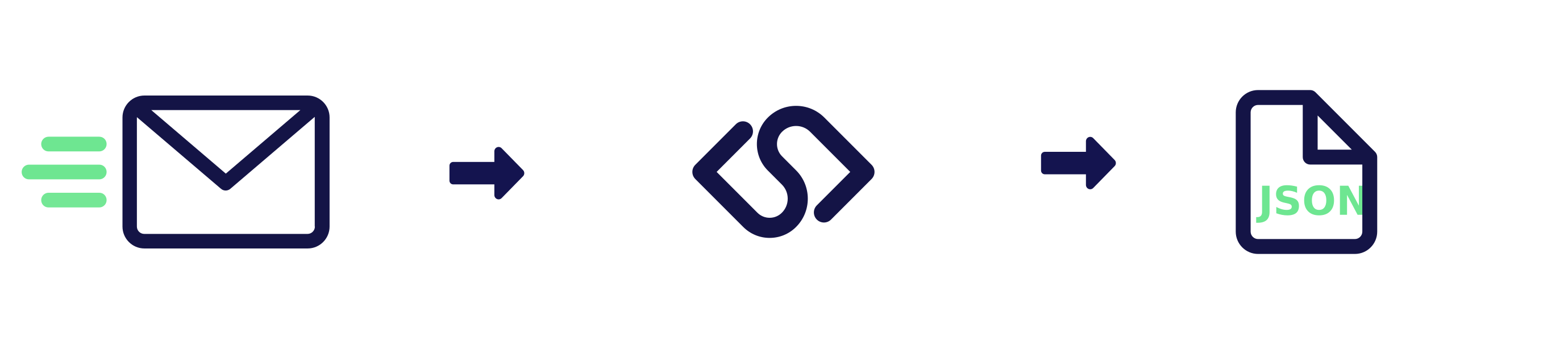
Parser soi-même des emails peut s’avérer complexe et chronophage… Nous analysons pour vous tous vos emails entrants sur votre domaine Inbound email et vous les envoyons via webhook au format JSON.

Logs détaillés

  • Logs en temps réel
  • Analysez en détail chacun des emails reçus et transmis via webhook
  • Utilisez nos filtres pour analyser les événements en cours ou passés
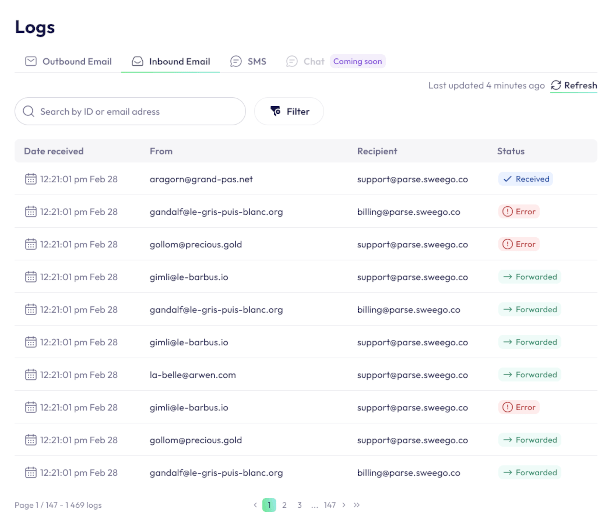
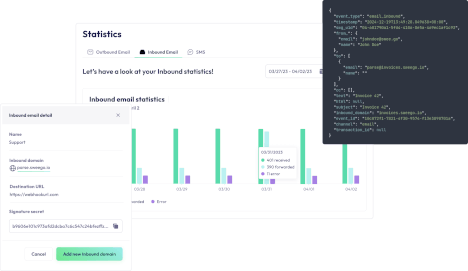
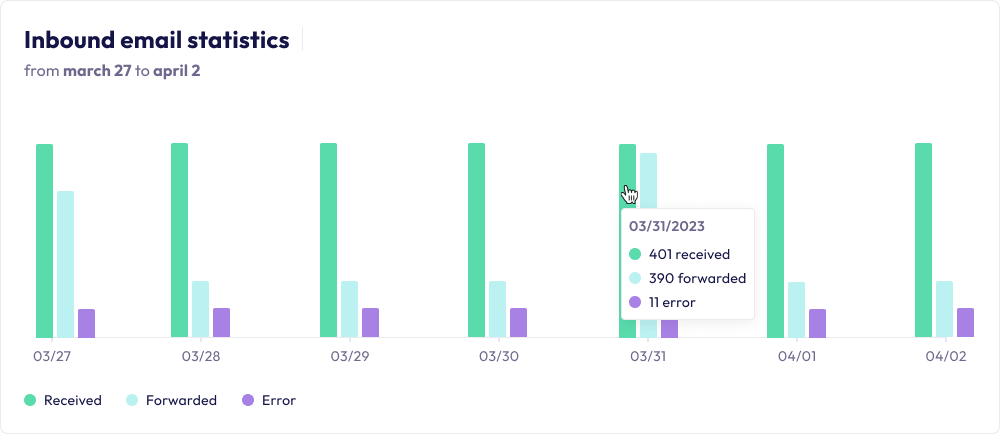
Statistiques de vos emails entrants

Pilotez le bon fonctionnement du routage de vos emails reçus.

Filtrez par domaine pour aller à l’essentiel et rechercher les boîtes mails utilisées en réception. Vous pouvez suivre en un coup d’œil les réponses sur les endpoints de vos webhooks

import requests
import json

url = "https://api.sweego.io/clients/:uuid_client/domains/inbound"

payload = json.dumps({
  "name": "string",
  "webhook_url": "string",
  "subdomain": "string",
  "uuid_domain": "string"
})
headers = {
  'Content-Type': 'application/json',
  'Accept': 'application/json',
  'Authorization': 'Bearer <TOKEN>'
}

response = requests.request("POST", url, headers=headers, data=payload)

print(response.text)
<?php

$curl = curl_init();

curl_setopt_array($curl, array(
  CURLOPT_URL => 'https://api.sweego.io/clients/:uuid_client/domains/inbound',
  CURLOPT_RETURNTRANSFER => true,
  CURLOPT_ENCODING => '',
  CURLOPT_MAXREDIRS => 10,
  CURLOPT_TIMEOUT => 0,
  CURLOPT_FOLLOWLOCATION => true,
  CURLOPT_HTTP_VERSION => CURL_HTTP_VERSION_1_1,
  CURLOPT_CUSTOMREQUEST => 'POST',
  CURLOPT_POSTFIELDS =>'{
  "name": "string",
  "webhook_url": "string",
  "subdomain": "string",
  "uuid_domain": "string"
}',
  CURLOPT_HTTPHEADER => array(
    'Content-Type: application/json',
    'Accept: application/json',
    'Authorization: Bearer <TOKEN>'
  ),
));

$response = curl_exec($curl);

curl_close($curl);
echo $response;
package main

import (
  "fmt"
  "net/http"
  "io/ioutil"
)

func main() {

  url := "https://api.sweego.io/clients/:uuid_client/domains/inbound"
  method := "GET"

  client := &http.Client {
  }
  req, err := http.NewRequest(method, url, nil)

  if err != nil {
    fmt.Println(err)
    return
  }
  req.Header.Add("Accept", "application/json")
  req.Header.Add("Authorization", "Bearer <TOKEN>")

  res, err := client.Do(req)
  if err != nil {
    fmt.Println(err)
    return
  }
  defer res.Body.Close()

  body, err := ioutil.ReadAll(res.Body)
  if err != nil {
    fmt.Println(err)
    return
  }
  fmt.Println(string(body))
}
const https = require('follow-redirects').https;
const fs = require('fs');

let options = {
  'method': 'POST',
  'hostname': 'api.sweego.io',
  'path': '/clients/:uuid_client/domains/inbound',
  'headers': {
    'Content-Type': 'application/json',
    'Accept': 'application/json',
    'Authorization': 'Bearer <TOKEN>'
  },
  'maxRedirects': 20
};

const req = https.request(options, (res) => {
  let chunks = [];

  res.on("data", (chunk) => {
    chunks.push(chunk);
  });

  res.on("end", (chunk) => {
    let body = Buffer.concat(chunks);
    console.log(body.toString());
  });

  res.on("error", (error) => {
    console.error(error);
  });
});

let postData = JSON.stringify({
  "name": "string",
  "webhook_url": "string",
  "subdomain": "string",
  "uuid_domain": "string"
});

req.write(postData);

req.end();
curl -L 'https://api.sweego.io/clients/:uuid_client/domains/inbound' \
-H 'Content-Type: application/json' \
-H 'Accept: application/json' \
-H 'Authorization: Bearer <TOKEN>' \
-d '{
  "name": "string",
  "webhook_url": "string",
  "subdomain": "string",
  "uuid_domain": "string"
}'