


Category: Channel

Sweego in the G2 Summer 2026 Reports: Three Categories and a New Best Support Badge
Sweego in the G2 Summer 2026 Reports: Three Categories and a New Best Support Badge This spring, Sweego made its debut in the G2 Grid® for transactional email. For the Summer 2026 edition, we’re reaching a new milestone: Sweego is now recognized across three separate categories — Transactional Email, Email Deliverability, and Communication Platform as…

What Is a Transactional Email? The Complete Guide to Definition, Examples, and Best Practices
Every time a user resets a password, confirms an order, or receives a shipping notification, a transactional email is doing the work behind the scenes. These automated, event-driven messages are the backbone of digital communication between applications and their users. For an Email Service Provider like Sweego, transactional email is the gold standard: it’s the…

Sweego Listed in the G2 Spring 2026 Report for Transactional Email
We are proud to announce that Sweego is featured in the G2 Spring 2026 Report for Transactional Email as “High Performer“. This is a first for us, and a concrete validation of what our users think of the platform day to day. This ranking is based exclusively on verified reviews from real users collected by…
Sending Emails from Payload CMS with Sweego
Payload CMS has established itself as one of the most popular headless CMS solutions in the TypeScript ecosystem. Code-first, strongly typed, and built for modern architectures — it’s a natural fit for teams who want full control over their stack. By default, Payload sends its system emails (password resets, user invitations, notifications) via Nodemailer. If…
VERP (Variable Envelope Return Path): Complete Guide to Managing Email Bounces
What is VERP? Definition and Principle VERP (Variable Envelope Return Path) is an emailing technique that enables automatic identification of invalid email addresses by using a unique return address for each recipient. This method revolutionizes bounce management (undelivered messages) for email platforms and mailing list managers. How VERP Works VERP is based on modifying the…

Post SMTP add Sweego API for WordPress Email Sending
We’re excited to announce that Sweego is now integrated with Post SMTP, one of the most popular WordPress email plugins with over 400,000 active installations! This integration allows WordPress users to easily configure Sweego as their transactional email provider, directly from their admin interface. Why Use Sweego with Post SMTP? Sweego is a transactional email…
Microsoft strengthens security for its deliverability tools: what’s changing for SNDS and JMRP
Microsoft has just announced a series of updates to its two flagship email reputation monitoring tools: SNDS (Smart Network Data Services) and JMRP (Junk Mail Reporting Program). These changes, part of a broader security enhancement initiative, deserve the attention of all professional senders. SNDS: mandatory authentication starting November 2025 The first major change already has…
SMTP service: simple, fast and hosted in Europe
When it comes to sending bulk or transactional emails, one term always comes up: the SMTP service. Whether you’re sending order confirmations, notifications, or newsletters, it’s the technical backbone of any reliable email delivery system. In this article, we’ll look at what an SMTP service is, how it works, and why Sweego stands out as…
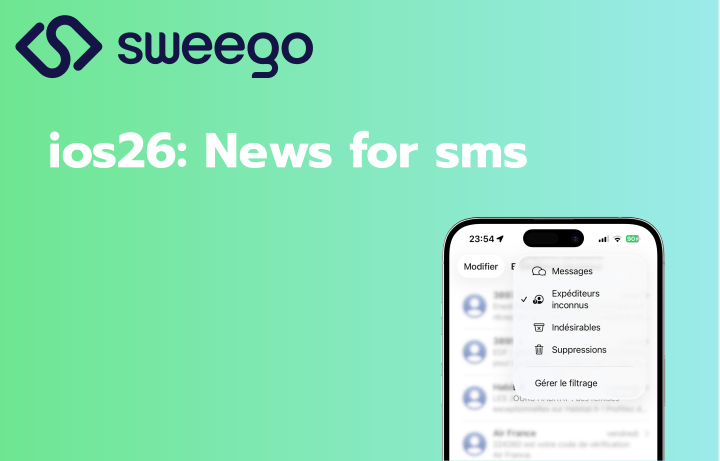

iOS 26: what’s changing for text messages
With iOS 26, Apple is improving the SMS experience..On the agenda: better filtering of unknown senders, the ability to customize conversations with backgrounds, the arrival of polls in group chats, and more precise typing indicators. What’s New for Users New Spam Folder iOS 26 introduces a real spam folder for SMS. Messages deemed suspicious are…

New Feedback Loop (FBL) mechanism via DNS
Published on March 3, 2025, Alex Brotman from Comcast proposed an IETF draft, “draft-brotman-dkim-fbl-04”. It introduces a new standardized method that allows mailbox providers to send user feedback directly to DKIM signers. Why does this matter? And how does it actually work? Let’s break it down. 🔁 What Is a Feedback Loop (FBL)? A Feedback…